Showing posts with label sheep. Show all posts

Tuesday, July 26, 2016

Penguins, Sea Kayaking, and Sheep – Oh My!


We tried something different this year – sea kayaking in Flea Bay or Pohatu (near Akaroa). Pohatu means the “place of stones” because the Maori had to remove so many stones from this area in order to till the ground and grow kumara – or sweet potato http://www.teara.govt.nz/en/1966/kumara . The pakeha (or foreigner) name was Flea Bay – because when the settlers picked up the abundant penguins in the area – they were covered in fleas and these proceeded to cover their arms.

The company that took the group started a unique conservation reserve called Tutakahikura Scenic Bush Reserve and they take folks kayaking through the marine reserve. Shireen and her husband were both farmers and bought the property and when they saw the penguins disappearing around the peninsula, they decided to do something about it and started protecting the penguins (see http://www.pohatu.co.nz/About+Us.html ). We were greeted by Benoit and and Kevin, our (French) guides through the land and marine reserve.

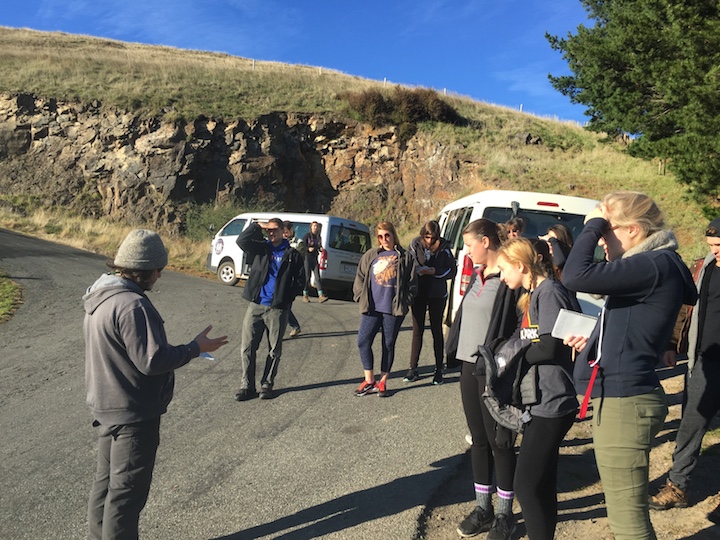
Hopping into two vans – we headed the road over to Flea Bay. From the top, we had quite a view of Akaroa Harbour, which is actually the crater of an extinct volcano over 6 million years ago.
View of Akaroa Harbour
Ben explains the origins of Akaroa Harbour
The class near the top

Along the way, we looked at a weta hotel and saw a Bank’s Peninsula tree weta Hemideina ricta. http://ecan.govt.nz/publications/General/banks-peninsula-tree-weta-brochure.pdf   These lovely wetas became really large – in the absence of mice and other small mammals – sort of taking over their niche. 


Checking out a weta hotel


This is a giant weta form the North Island
Banks Peninsula tree weta in the hotel that we saw today

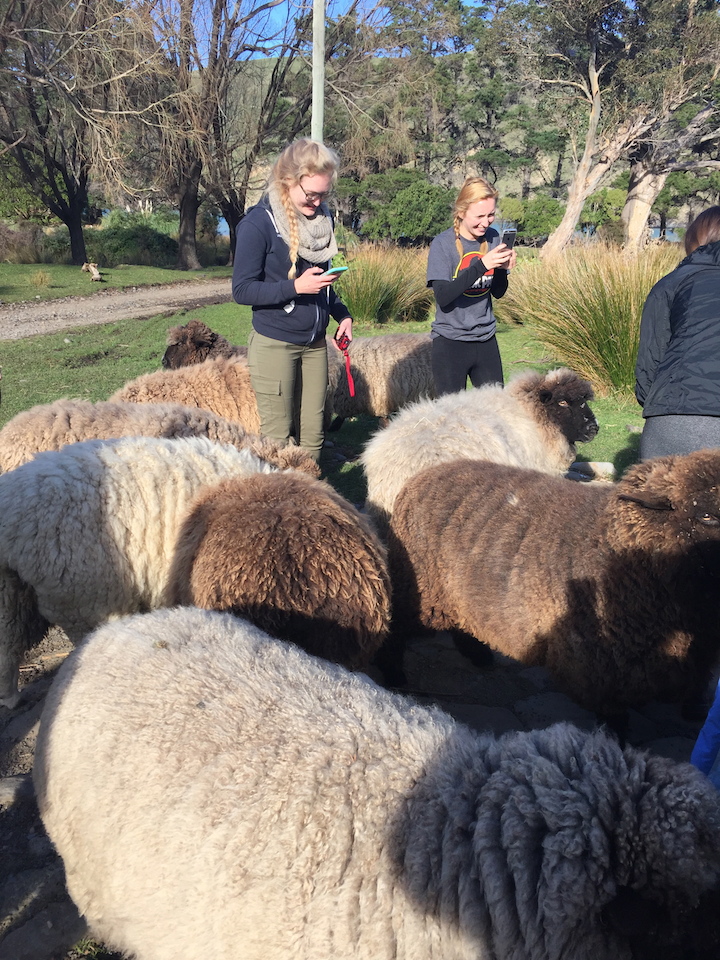
We dropped down into the bay and begun our preparations. We were instantly surrounded by some shaggy brown sheep – much to the delight of the class. We got to feed them!

Over here!

More?
After safety instructions and some instructions about the sea kayaks, we entered the water on a beautiful sunny day. The water was a nice turquoise blue and we began to look for white-flippered penguins Eudyptula albosignata http://www.penguin.org.nz/white-flippered-penquin.html and Hector’s dolphins Cephalorhynchus hectori. http://www.doc.govt.nz/nature/native-animals/marine-mammals/dolphins/hectors-dolphin/  Both species are rare and endangered.

First up though were New Zealand fur seals Arctocephalus forsteri basking on the rocks. As we paddled by, they were basking on the rocks. They lazily lifted up their heads as we paddled by. 
Out into the bay!
Grouping together as we head towards the penguin colonies
Tupelo giving it her all
Then, Kevin pointed out our first white-flippered peguin along the rocks. Amazing! These penguins are unique only to Banks Peninsula and at one time numbered in the tens of thousands but were reduced quite dramatically due to predators (e.g., rats, cats, dogs, and stoats).  The penguins dig/find burrows on shore and this is where they are vulnerable to introduced predators. There is an extensive predator control program in the area. Even grazing sheep help because they prevent the exotic grasses form seeding out – and this reduces the amount of food for rats and mice. Currently, it is estimated that there are about one thousand penguins nesting in the area. 

Cute penguins huddled on the rocks
As we got out towards the ocean, we saw Hector’s dolphins. These little guys (they grow 1.5 m in length) are highly endangered, affected by fishing nets and boat propellers. The Banks Peninsula marine mammal sanctuary in Canterbury was established in 1988 primarily to reduce set-net deaths of Hector’s dolphins in the area.

We returned to shore, dragged up the kayaks, and cleaned the gear. We were introduced (to our surprise) a pair of penguins nesting right by the boat shed. 
Hello there!
Ok guys - cover us back up!
We had lunch and headed back over the hill. next stop was tea time and then back to Lincoln. We leave for Kaikoura tomorrow and will have limited internet connection. So more in a few days! 

Cheers Dr. H
One last look at Flea Bay


Tuesday, July 19, 2016

Hinawai and Hugh Wilson – National Treasures


Today we are at Hinewai Reserve near Akaroa.  Managed by renown botanist, Hugh Wilson, this 3,000 acre reserve is a wonderful example of nature regenerating itself.  What was once gorse-infested farmland is now beach forest after just 20 or so years.  Much to the dismay of early critics, Hugh’s successful philosophy is that the gorse makes a good planting bed for natives and protects them from wind and predators with its spiny bark.  The natives grow up through the gorse and then shade it out and kill it.

Hugh draws and writes everything by hand.  Here is an overview of the reserve neatly drawn out by him.
What was an old wood shed on the property is now a Visitor's Center/Lodge where we will stay the night.
A ground weta welcomed Mimi to the Lodge : )

The view from the top of our hike down to Long Bay beach.  Note the yellow-flowering gorse in the photo, and the green beech forest on the hillside on the right (where the hike went through down to the beach).  Contrast with the patch of mowed-by-sheep farmland down by the beach.
With the big 600 year old Totara
Some of Hugh's illustrations of birds in Hinewai

Hugh, getting ready to go to work at the top of the hill where he is helping to manage additional property adding to the Hinewai Reserve area through another trust.  Hugh HATES cars and says the secret to staying young and healthy is to have nothing to do with them.  After I took this picture, he added five large wood stakes to the back of his bike before heading off up the hill.
We hiked from the top of Hinewai where we will stay tonight at the Visitor’s Center/Lodge (very rustic old wood shed, but comfy) down to Long Bay beach. Along the way we saw many native plants and birds.  At the bottom we got to see rare, native kakariki parrots that Hugh’s helper, Paul, has a special license to keep as pets, and hunted for Paua shell at Long Bay beach.  We also got to see a lot of sheep up close and personal as the farmer that lives at the edge of the beach just outside of the reserve was running sheep into another paddock where we were hiking - very exciting. 
Hard to imagine this hillside of natives bare farmland just 20 years ago

Native Kakariki


LOTS of sheep

Grace outstanding in a field with the sheep

Long Bay beach on a cool grey winter day

Amber found not only paua but also a sponge

Hanging out at Long Bay beach

In the late afternoon and back up at the Lodge, we played games, Hugh told us the history of Hinewai, and we enjoyed a yummy meal together.


Hugh tells us the story of Hinewai
Thank you Hugh!  We love Hinewai and you!
The gang and Mark will spend the night at the Visitor Center/Lodge at Hinewai.  They have 11 bunks there and a log burner to keep them (mostly) warm.  Stay Warm And Sweet Dreams Everyone, Meryl : )

Monday, July 4, 2016

July 4th – Kiwi Style


Well, today is July 4th in New Zealand but it is actually July 3rd in the U.S., but never mind that, we consider it July 4th anyway. This morning, the class started the morning with a hearty helping of beans and toast, cereal, and perhaps Vegemite on toast!? They had orientation and several lectures in the morning and early afternoon  – and they stayed awake! – a very resilient class as jet lag can take several days to recover.

Lectures covered principles and techniques to conserve and restore biodiversity in New Zealand. New Zealand has many endemic plants and animals (found nowhere else in the world) and with the introduction of humans (Maori about 800-900 years ago) and then Europeans, many species went extinct and currently many are in danger of going extinct. Due to habitat loss and the introduction of many invasive exotics, such as brushtail possums and rats, both New Zealand plants and animals (including humans!) are under pressure.  Some of the large birds, called Moas (see dramatization of Moa being hunted by Maori), use to roam the forests and took over the browsing role of mammals. Terrestrial mammals were not historically present in New Zealand. Hence the introduction of possums, rats, deer, etc, have caused havoc with New Zealand flora and fauna. Native plants and animals do not have defenses against them and plants are eaten at will and mammal predators eat native birds and lizards.

Two quests for the class (over there stay here) are to find a velvet worm, (do see this video of velvet worm hunting a beetle) and a huhu bug (do see this hunt for the elusive huhu bug ). The Maori have been eating these huhu grubs for centuries and it is supposedly quite tasty, and I (anybody else?) will try one (if we find it!).

After lunch, we had several more lectures covering design, construction and postconstruction issues surrounding green developments. Green developments are not easy to do but do minimize impacts on our natural resources if designed and managed well. 

The classs decided to go on a hike and  we stopped for “tea time” at coffee culture to sample flat whites, hot chocolate, and muffins.
At Coffee Culture

Hmm Mochaccino
We continued on to Halswell Quarry for hike that led us to some adorable black-faced sheep (probably Suffolk breed – see many New Zealandvarieties here ). heard a new term for these sheep “Shangles.” (angelic sheep).
Up the path - towards sheep

SHEEP!
Uhhh - more sheep?

How the light changes in New Zealand
In front of a Korean Sculpture in the gardens near Halswell

We hiked around the quarry where early pioneers used the stone to build homes and roads in Christchurch (see history ). We encountered several native plants including, cabbage tree, Ngaio, hebe, manuka, and kanuka. Manuka honey is valued throughout the world as having healing qualities.

We ended the day with a beautiful sunset and a trip to New World supermarket before dinner. Nighty night! Dr. H

Sunset over Christchurch