We tried something different this year – sea kayaking in
Flea Bay or Pohatu (near Akaroa). Pohatu means the “place of stones” because
the Maori had to remove so many stones from this area in order to till the ground and grow kumara – or sweet potato http://www.teara.govt.nz/en/1966/kumara
. The pakeha (or foreigner) name was Flea Bay – because when the settlers picked
up the abundant penguins in the area – they were covered in fleas and these
proceeded to cover their arms.
The company that took the group started a unique
conservation reserve called Tutakahikura Scenic Bush Reserve and they take folks kayaking through the marine reserve. Shireen and her husband were both farmers and bought the property and when they saw the penguins disappearing around the peninsula, they decided to do something about it and started protecting the penguins (see http://www.pohatu.co.nz/About+Us.html ). We
were greeted by Benoit and and Kevin, our (French) guides through the land and marine reserve.
Hopping into two vans – we headed the
road over to Flea Bay. From the top, we had quite a view of Akaroa Harbour, which is actually the crater of an extinct volcano over 6 million years ago.
 |
| View of Akaroa Harbour |
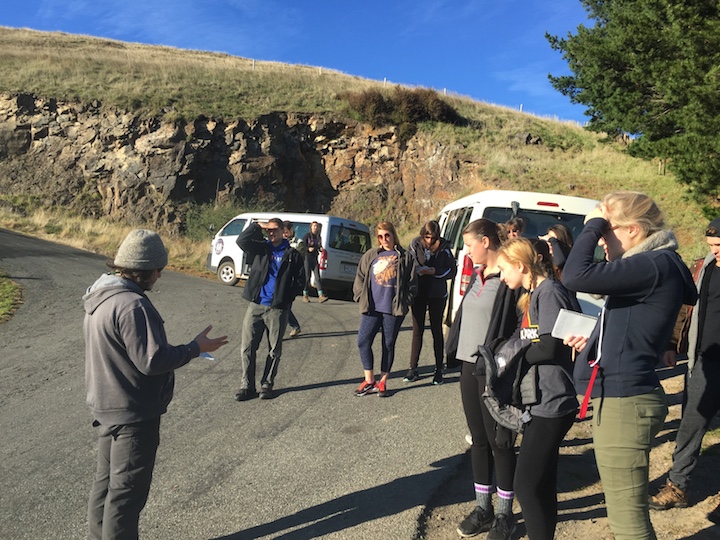 |
| Ben explains the origins of Akaroa Harbour |
 |
| The class near the top |
Along the way, we looked at a weta hotel and saw a Bank’s Peninsula tree weta
Hemideina ricta. http://ecan.govt.nz/publications/General/banks-peninsula-tree-weta-brochure.pdf These lovely wetas became really large – in
the absence of mice and other small mammals – sort of taking over their niche.
 | |||||
| Checking out a weta hotel |
 | |
| This is a giant weta form the North Island |
 |
| Banks Peninsula tree weta in the hotel that we saw today |
We dropped down into the bay and begun
our preparations. We were instantly surrounded by some shaggy brown sheep – much
to the delight of the class. We got to feed them!
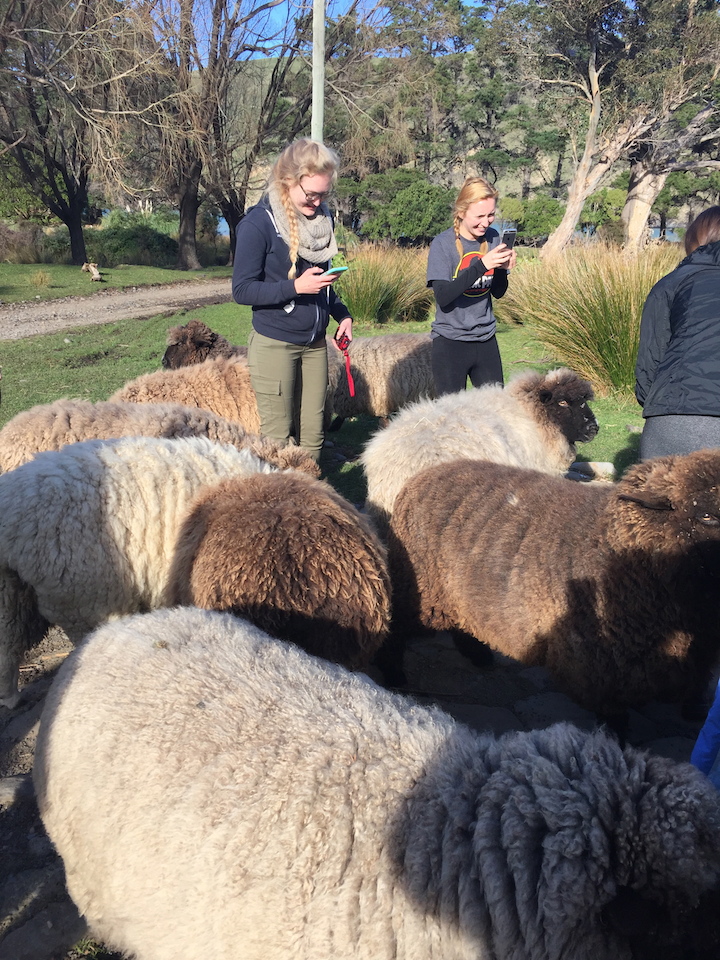 |
| Over here! |
 |
| More? |
After safety instructions and some
instructions about the sea kayaks, we entered the water on a beautiful sunny
day. The water was a nice turquoise blue and we began to look for
white-flippered penguins Eudyptula albosignata http://www.penguin.org.nz/white-flippered-penquin.html
and Hector’s dolphins Cephalorhynchus hectori. http://www.doc.govt.nz/nature/native-animals/marine-mammals/dolphins/hectors-dolphin/
Both species are rare and endangered.
First up though were New Zealand fur
seals Arctocephalus forsteri basking on the rocks. As we paddled by, they were
basking on the rocks. They lazily lifted up their heads as we paddled by.
 |
| Out into the bay! |
 |
| Grouping together as we head towards the penguin colonies |
 |
| Tupelo giving it her all |
Then, Kevin pointed out our first
white-flippered peguin along the rocks. Amazing! These penguins are unique only
to Banks Peninsula and at one time numbered in the tens of thousands but were
reduced quite dramatically due to predators (e.g., rats, cats, dogs, and
stoats). The penguins dig/find burrows
on shore and this is where they are vulnerable to introduced predators. There
is an extensive predator control program in the area. Even grazing sheep help
because they prevent the exotic grasses form seeding out – and this reduces the
amount of food for rats and mice. Currently, it is estimated that there are
about one thousand penguins nesting in the area.
 |
| Cute penguins huddled on the rocks |
As we got out towards the ocean, we saw
Hector’s dolphins. These little guys (they grow 1.5 m in length) are highly
endangered, affected by fishing nets and boat propellers. The Banks Peninsula
marine mammal sanctuary in Canterbury was established in 1988 primarily to
reduce set-net deaths of Hector’s dolphins in the area.
We returned to shore, dragged up the kayaks, and cleaned the gear. We were introduced (to our surprise) a pair of penguins nesting right by the boat shed.
We had lunch and headed back over the hill. next stop was tea time and then back to Lincoln. We leave for Kaikoura tomorrow and will have limited internet connection. So more in a few days!
Cheers Dr. H
 |
| Hello there! |
 |
| Ok guys - cover us back up! |
Cheers Dr. H
 |
| One last look at Flea Bay |