Showing posts with label Hiking. Show all posts

Thursday, July 21, 2016

Port Hills Panorama


On tap for today, my favorite hike in the Port Hills - the Crater Rim Walkway section near Omahu Bush Reserve which offers 360 views that include the Pacific Ocean, Birdlings Flat, Lake Ellesmere, the Canterbury Plains/Christchurch area and views to the Southern Alps and of Lyttelton Harbor, Diamond Harbor, and Quail Island.  It was the perfect day for it – sunny, warm, and with a light breeze. We hiked up to a large rocky outcrop where we ate our lunch and enjoyed the views and some peaceful down time.


After driving along the Summit Drive of the Port Hills we headed down to Governor's Bay to explore the rocks and look for sea life whilst (as they say here) the tide was still out a bit.  We found little crabs under rocks, a chiton, and enjoyed the views out to the sea along the rocky shore.


Then we were off for a decadent tea time at She Universe which features ever manner of fine chocolate and a beautiful view of Governor's Bay. It was fun to sip hot and cold chocolate drinks and watch the large barges bring containers full of goods to Lyttelton Harbor to be off-loaded.


We headed back mid-afternoon so that everyone would have time to do laundry and get packed up for their free weekend.  Be safe and have fun everyone!  Look forward to hearing about your adventures on Sunday when we are all back together.  Stay Tuned, Meryl : )

Tuesday, July 19, 2016

Hinawai and Hugh Wilson – National Treasures


Today we are at Hinewai Reserve near Akaroa.  Managed by renown botanist, Hugh Wilson, this 3,000 acre reserve is a wonderful example of nature regenerating itself.  What was once gorse-infested farmland is now beach forest after just 20 or so years.  Much to the dismay of early critics, Hugh’s successful philosophy is that the gorse makes a good planting bed for natives and protects them from wind and predators with its spiny bark.  The natives grow up through the gorse and then shade it out and kill it.

Hugh draws and writes everything by hand.  Here is an overview of the reserve neatly drawn out by him.
What was an old wood shed on the property is now a Visitor's Center/Lodge where we will stay the night.
A ground weta welcomed Mimi to the Lodge : )

The view from the top of our hike down to Long Bay beach.  Note the yellow-flowering gorse in the photo, and the green beech forest on the hillside on the right (where the hike went through down to the beach).  Contrast with the patch of mowed-by-sheep farmland down by the beach.
With the big 600 year old Totara
Some of Hugh's illustrations of birds in Hinewai

Hugh, getting ready to go to work at the top of the hill where he is helping to manage additional property adding to the Hinewai Reserve area through another trust.  Hugh HATES cars and says the secret to staying young and healthy is to have nothing to do with them.  After I took this picture, he added five large wood stakes to the back of his bike before heading off up the hill.
We hiked from the top of Hinewai where we will stay tonight at the Visitor’s Center/Lodge (very rustic old wood shed, but comfy) down to Long Bay beach. Along the way we saw many native plants and birds.  At the bottom we got to see rare, native kakariki parrots that Hugh’s helper, Paul, has a special license to keep as pets, and hunted for Paua shell at Long Bay beach.  We also got to see a lot of sheep up close and personal as the farmer that lives at the edge of the beach just outside of the reserve was running sheep into another paddock where we were hiking - very exciting. 
Hard to imagine this hillside of natives bare farmland just 20 years ago

Native Kakariki


LOTS of sheep

Grace outstanding in a field with the sheep

Long Bay beach on a cool grey winter day

Amber found not only paua but also a sponge

Hanging out at Long Bay beach

In the late afternoon and back up at the Lodge, we played games, Hugh told us the history of Hinewai, and we enjoyed a yummy meal together.


Hugh tells us the story of Hinewai
Thank you Hugh!  We love Hinewai and you!
The gang and Mark will spend the night at the Visitor Center/Lodge at Hinewai.  They have 11 bunks there and a log burner to keep them (mostly) warm.  Stay Warm And Sweet Dreams Everyone, Meryl : )

Sunday, July 17, 2016

Quail Island (but no quails)


Our early morning began with a ferry ride to Quail Island, also referred to as Otamahua in Maori. Our group met up with a small group from the Quail Island Restoration Trust to pot out Silver tussock. While the project was being set up, Lindsey, one of the trustees, took us on a small hike and explained some of the island's interesting history. The island is actually the caldera of the 6 million year old shield volcano, Lyttelton. It’s referred to as Quail Island because the first European sent to explore it was greeted by (now extinct) quails when he arrived. The island has also been used as quarantine for lepers and as a preparation site for excursions to the arctic. When the restoration trust began work on the island in 1998, it was desolate of native plants due to previous farming. Since then, it is now covered in native plants. Lindsey showed us how the exotic grasses couldn’t grow back since the natives had created so much debris. 
(tussock planted last week)
(tussock planted 5 years ago)


After our small hike, we began our restoration. Previously planted Silver tussocks were pulled apart to create multiple smaller tussocks. If the plant had roots and some green stems, we planted them in individual pots. Some of us filled pots with soil, others planted the tussock, and others carried all the plants to the same collective spot. With each native plant that is planted, it's helping establish native ecosystems on the island. 
(each of us were given masks to avoid Legionnaires' Disease)


After everyone’s hard work, we had potted over 200 tussocks that will be replanted later in the future! 

 We broke for lunch and Dr. H decided to add a little extra protein to his. After searching for 6 years, Tupelo found the huhu grub that Dr. H had promised to eat if ever found. He claimed it did in fact taste like peanut butter. Maris even had a little taste for herself!


Then we took a hike around the island and enjoyed the breathtaking scenery and aqua blue water. 

At one point, we all started flipping over rocks in search of the Canterbury gecko. We were successful in finding even more unique animals!

(Mokomoko, common skink)

(yellow admiral caterpillar)
(Canterbury gecko)

 
(fiddler crab)


The weather held up just long enough for us to sit by the beach and finish our walk. It was very kind of the Quail Island Restoration Trust to allow us to come out and help them today. We took the ferry back to the mainland and (of course) stopped for tea time to warm up from the damp, cold weather.

Till tomorrow, Amber! 


Friday, July 15, 2016

There and Back Again: An Environmental Tale by the Student Kiwis

This eventful day began at the farm of two local landowners, Malcolm and Pauline. This couple bought a 15 hectare piece of land, originally with only three trees, and converted it to a beautiful sanctuary for many native New Zealand species of plants and birds. They were generous enough to allow us to plant ten Stevens Island pittosporum on their property.

Pauline (Right) and the Students
Malcolm (Middle) Assisting in the Planting Process
Steven Island Pittosporum 

Malcolm taught us planting techniques, using a small stick made of wood from a Manuka to pound the dirt in around the plant to ensure the roots would catch in the soil and begin to grow downwards and attain vital nutrients. Malcolm instructed us to dig deep enough to reach a layer of soft moist clay about a foot into the earth. We planted the pittosporum very close to each other, which allows the roots to form in a way that acts as a shield against exotic weeds attempting to sprout up between the plants. 
Amber and Emma Planting

Following the planting of the pittosporum, Pauline led us on a circle around the property, pointing out features of their farm as well as the native and exotic species they have planted. Some exotics can provide food for several native species of bird, such as the Bellbird. The exotic Crab Apple trees  provide the birds with the red berries produced by the tree. 

The square hedges require a lot of maintenance, being trimmed once a year. Native hedges are less maintenance,
Pauline and Malcolm's House
Kowhai Plant ~ 4 Years Old


Malcolm explained the problem he has with rabbits and hares eating the native vegetation. This is a problem throughout New Zealand. He uses 'liquid shotgun' on his plants, a mixture of rotten eggs that smells to deter these pests. He personally shoots around 15-20 rabbits per year just on his property.
Pauline Pointing out the plant diversity on their farm. These are Lemonwoods.
Ake Ake
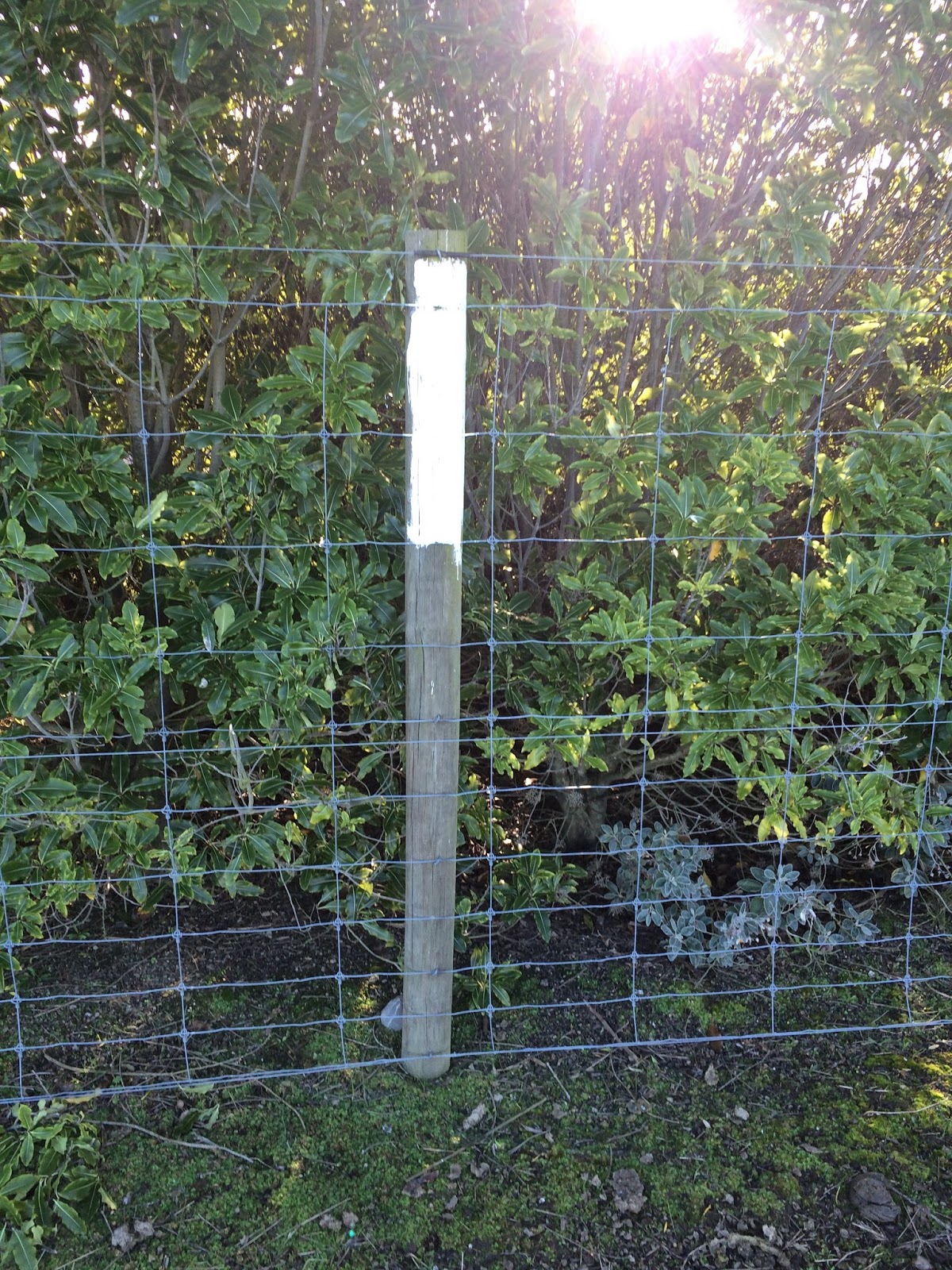
These white posts indicate where Malcolm uses electric fencing to separate the cows and sheep into areas he wants them to graze. While we were there, however, there were none.
This is Leppers Track, a small path surrounded by Hebe plants which allow students to walk to school and keep a good distance from the road. It is a great combination of safety and the incorporation of native plants into society. 
Pauline and Malcolm planted flax (middle) and cabbage trees (top right) on the edge of their property to attempt to attract Tui birds. They hope to have some inhabiting their lands in the coming years.
These Kowhai seeds are very resilient, and can even withstand being dropped in the ocean and washed ashore. The hard shells make way for small yellow seeds inside. 
Rimu (right) Totara (left)
The shrubs on the left along the path are all natives. Some were from the North Island. Some nursery's advertise whether or not they ecosource their plants. Ideally, all of the native vegetation planted would be sourced from the surrounding area. However, this isn't always easy.  
After the tour of the property Malcom and Pauline invited us inside for hot drinks and home made muffins. Their house was amazing, full of big windows with a lot of natural light and views looking out onto their farm. 
Grace and Maris were quite pleased with the muffins
Signing their Guestbook
The second half of the day was spent on a property overlooked by the Banks Peninsula Land Trust. The owner of the land, Richard, and an organizer from the trust, Annelise, spent the day with us weeding a harmful exotic plant from the hillside. The weed is named Scottish Broom. This particular piece of land was the first covenant of the Banks Peninsula Trust. The goal of the trust is to work with land owners to preserve the of the land and its native processes while at the same time offering benefits to the land owners. 

Meeting with Richard and Annelise
The top of the ridge we met them on was particularly windy. We ate our lunch, provided by Lincoln University, in the van.
To reach the hillside on which the Scottish Broom was growing, we had to hike quite a long ways uphill. However, the views were incredible.
Richard offered rides on his ATV up the hill
Helmets of course!
A young version of Scottish Broom. Some of these grew to be quite big, more like trees than weeds!
Scottish Broom
We went to work with hand saws and herbicide to kill the harmful exotic species.
Some of the Scottish Broom was in difficult places to reach on the side of the hill. "When in doubt, send your bum down first" - Richard.
After the hard days work, we hung out with some cows on the roadside.
We ended the great day with ice cream provided by Dr. Meurk. 

Cheers. - Matt