Showing posts with label Green Development. Show all posts

Saturday, July 30, 2016

Kaikoura

Our first stop on our way to Kaikoura was Pegasus Town, one of the largest green developments in the Canterbury region with around 1300-1500 homes.  

The development is about six years old, but is likely 20 years from being completely finished.  The builders and homeowners are able to plant natives within individual lots at their own discretion, but all houses within the development must meet sustainable energy efficiency specifications.  Some more green features include swales for drainage and high-density housing  (small lots are placed close together with larger areas of shared open green space among houses).  


The development neighbors the Tuhaitara Coastal Park, in which the developers have made efforts to begin restoring native vegetation in some areas.


Our next stop was for teatime at Pukeko Junction.


       Several hours later, we arrived in Kaikoura!  (Kai meaning land, koura meaning crayfish- land of the crayfish!) We first stopped for lunch at a local beach and then headed to the New Zealand fur seal sanctuary and enjoyed a closer look of lounging, playing, and barking seals!  


      The fur seals were once abundant throughout the country and have been under full government protection from hunting since 1946.  The current population is roughly 100,000 seals, however, that is estimated to be only 10-20% of the original population prior to the increase in hunting in the mid 1700’s.


        After admiring the seals from the viewing platform, we took a short drive to a mystery hike.  

        We walked about 10-15 minutes before reaching the hidden jewel- the Ohau Stream Seal Pups.  


      A hidden waterfall sanctuary acts as a nursery for up to 200 seal pups every winter, giving these young, gregarious animals a chance to develop important social and motor skills.  They return down the stream every few days for their mother’s milk until they reach about a year in age and leave the safety of the waterfall for good.  Sadly, we couldn’t spend the entire day watching the little pups chase each other in their gorgeous home and made our way back down the path to the van.

     We had just enough time for a quick souvenir-shopping trip in Kaikoura before we left to attend the Powhiri, or formal greeting, at Takahanga Marae.   The house and grounds are sacred and after a brief overview of the Powhiri process outside the grounds, we entered the Marae and the welcome ceremony began.  The welcome was conducting almost entirely in Maori, and includes first a welcome to the ancestors of both the hosts and the Manuhiri (visitors), before welcoming the guests.  Each group sang a song; the Takahanga sang a traditional Maori song that was beautiful and filled the building with a rich harmony.  (we sang Stand by Me, by Ben E. King, and did our best J ).  After a few closing words, we did the Hongi, which is a Maori traditional greeting in which each person presses their nose and forehead against one another.

      Once the formal ceremony was over, we enjoyed tea and pastries before returning to the meetinghouse for a more in depth discussion and introduction to the Takahanga Marae.  This discussion including a history of the intricately carved decorative panels covering the walls and ceilings of the Marae that depict the history of the Iwi (tribe) and its connections to the region, Maori gods, and neighboring tribes.  Sadly, no photography is permitted inside the Marae and my words can’t do the ceremony or the building’s artwork justice- but it was a truly magical experience.  After the introduction and history of the Takahanga Marae, we went to dinner at Tiki Takeway, which has been voted the best fish and chips shop on the South Island, and the second best shop in all of New Zealand. We then returned to the Marae and got settled in for the night.

-Mimi


Friday, July 15, 2016

There and Back Again: An Environmental Tale by the Student Kiwis

This eventful day began at the farm of two local landowners, Malcolm and Pauline. This couple bought a 15 hectare piece of land, originally with only three trees, and converted it to a beautiful sanctuary for many native New Zealand species of plants and birds. They were generous enough to allow us to plant ten Stevens Island pittosporum on their property.

Pauline (Right) and the Students
Malcolm (Middle) Assisting in the Planting Process
Steven Island Pittosporum 

Malcolm taught us planting techniques, using a small stick made of wood from a Manuka to pound the dirt in around the plant to ensure the roots would catch in the soil and begin to grow downwards and attain vital nutrients. Malcolm instructed us to dig deep enough to reach a layer of soft moist clay about a foot into the earth. We planted the pittosporum very close to each other, which allows the roots to form in a way that acts as a shield against exotic weeds attempting to sprout up between the plants. 
Amber and Emma Planting

Following the planting of the pittosporum, Pauline led us on a circle around the property, pointing out features of their farm as well as the native and exotic species they have planted. Some exotics can provide food for several native species of bird, such as the Bellbird. The exotic Crab Apple trees  provide the birds with the red berries produced by the tree. 

The square hedges require a lot of maintenance, being trimmed once a year. Native hedges are less maintenance,
Pauline and Malcolm's House
Kowhai Plant ~ 4 Years Old


Malcolm explained the problem he has with rabbits and hares eating the native vegetation. This is a problem throughout New Zealand. He uses 'liquid shotgun' on his plants, a mixture of rotten eggs that smells to deter these pests. He personally shoots around 15-20 rabbits per year just on his property.
Pauline Pointing out the plant diversity on their farm. These are Lemonwoods.
Ake Ake
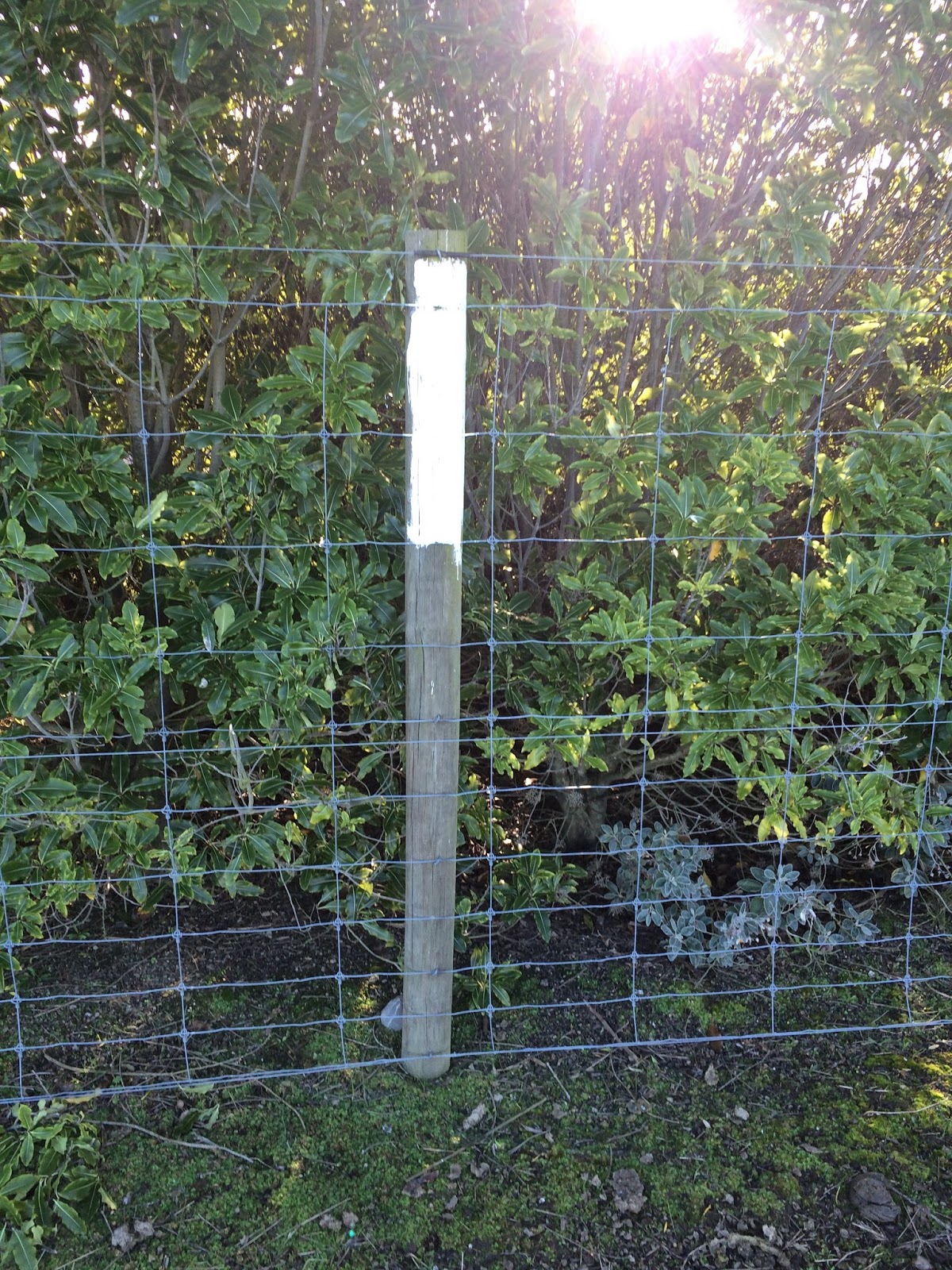
These white posts indicate where Malcolm uses electric fencing to separate the cows and sheep into areas he wants them to graze. While we were there, however, there were none.
This is Leppers Track, a small path surrounded by Hebe plants which allow students to walk to school and keep a good distance from the road. It is a great combination of safety and the incorporation of native plants into society. 
Pauline and Malcolm planted flax (middle) and cabbage trees (top right) on the edge of their property to attempt to attract Tui birds. They hope to have some inhabiting their lands in the coming years.
These Kowhai seeds are very resilient, and can even withstand being dropped in the ocean and washed ashore. The hard shells make way for small yellow seeds inside. 
Rimu (right) Totara (left)
The shrubs on the left along the path are all natives. Some were from the North Island. Some nursery's advertise whether or not they ecosource their plants. Ideally, all of the native vegetation planted would be sourced from the surrounding area. However, this isn't always easy.  
After the tour of the property Malcom and Pauline invited us inside for hot drinks and home made muffins. Their house was amazing, full of big windows with a lot of natural light and views looking out onto their farm. 
Grace and Maris were quite pleased with the muffins
Signing their Guestbook
The second half of the day was spent on a property overlooked by the Banks Peninsula Land Trust. The owner of the land, Richard, and an organizer from the trust, Annelise, spent the day with us weeding a harmful exotic plant from the hillside. The weed is named Scottish Broom. This particular piece of land was the first covenant of the Banks Peninsula Trust. The goal of the trust is to work with land owners to preserve the of the land and its native processes while at the same time offering benefits to the land owners. 

Meeting with Richard and Annelise
The top of the ridge we met them on was particularly windy. We ate our lunch, provided by Lincoln University, in the van.
To reach the hillside on which the Scottish Broom was growing, we had to hike quite a long ways uphill. However, the views were incredible.
Richard offered rides on his ATV up the hill
Helmets of course!
A young version of Scottish Broom. Some of these grew to be quite big, more like trees than weeds!
Scottish Broom
We went to work with hand saws and herbicide to kill the harmful exotic species.
Some of the Scottish Broom was in difficult places to reach on the side of the hill. "When in doubt, send your bum down first" - Richard.
After the hard days work, we hung out with some cows on the roadside.
We ended the great day with ice cream provided by Dr. Meurk. 

Cheers. - Matt 


Thursday, July 14, 2016

A Break from the Bush: Human Geography Lecture, Shopping, and the Movies

Instead of hiking and gallivanting through the forest, today we took a break from the bush and spent the day learning about Christchurch and human geography, shopping, and going to the movies. 
We began the day by meeting with Eric Pawson, who is a professor of Cultural, Environmental and Historical Geography at the University of Canterbury. We held our outdoor discussion at Cracroft Reserve, where we could see the Canterbury plains and the Southern Alps in the distance. 


Dr. Pawson began by discussing the geography of the Canterbury Plains, which is made up of numerous fans of gravel that have been accumulating since the last Ice Age and the deltas of rivers such as the Waimakariri. Flooding and other hydrological behavior is determined by the mountains, but much of the regional taxes are used to build flood defenses and prevent the natural hydrological behavior. Between the gravel fans is a series of smaller rivers, whose hydrological behavior is controlled by the southerlies from Antarctica.


Christchurch, which was founded in 1850, was built on several thousand meters of gravel, which makes the area unstable as well as prone to earthquakes and flooding. Although the flood and earthquake risks where known facts, it was assumed the earthquake risk would come from the Alpine Fault, which runs the length of the country and is where the Pacific plate and the Indo-Australian plate meet. However, the series of earthquakes that began in September 2010 did not originate from this fault, but rather from a previously unknown network of faults underneath the city.
The worst of the earthquakes happened in February 2011 and occurred directly under the city, resulting in the death of nearly 200 people. Much of the destruction was caused by liquefaction, which destroyed the foundations of buildings. The Central Business District of Christchurch was one of the areas hit hardest, partially because it was built on former swampland. Seventy percent of the CBD had to be demolished as a result of damage caused by liquefaction. Virtually all houses close to a river or stream were destroyed, and thousands houses built on younger sediment in the delta were rendered inhabitable, creating what is now called the Residential Redzone.
In response to the destruction, organizations such as the Student Volunteer Army and the Farmy Army (made up of farmers) helped suburbs damaged by liquefaction.
Rebuilding Christchurch will take many years, and many are using the earthquakes as an opportunity to improve the city. The city must address not only the possibly of more earthquakes, but also potential effects of climate change such as flooding caused by rising sea levels. As the city is rebuilt, many new green initiatives are being taken on and there is a new focus on art and innovation. Dr. Pawson mentioned that adaptive and temporary urbanism are being explored and citizens are becoming increasingly involved. Although many positive improvements and innovations have been made, much of Christchurch still needs to be rebuilt and there is debate about what to do with inhabitable areas such as the Residential Redzone and the future of Christchurch.

After learning about the earthquakes and the challenges faced by the people of Christchurch, we continued our discussion with Dr. Pawson at a local coffee shop, The Cup, where he gave us packets of information about the history and rebuilding of Christchurch. He also gave us information about Hugh Wilson, a famous botanist and keeper of the Hinewai Reserve who we are all very excited to meet next week.


After tea-time, we gave our thanks to Dr. Pawson and made our way to Victoria Park to eat lunch. We then went to The Tannery, which is a modern shopping center converted from an old 19th century tannery. There were a wide variety of shops including a bookstore, fabric store, numerous clothing stores, a flower shop, and a bakery. Many of the shops sold items made exclusively in Christchurch or other parts of New Zealand. 


After a little shopping, we met up at the movie theater in the shopping center to see the film Hunt for the Wilderpeople, which was written and directed by Taika Waititi and filmed in New Zealand. The film tells the story of a foster boy who embarks on an adventure in the New Zealand forest with his caretaker while running from the police and Child Welfare. The film was funny and heartwarming, and all of us enjoyed it immensely.


- Grace